Everything You Need to Know to Start Investing Stocks

To many of us, the stock market can be daunting (to say the very to the lowest degree). We know that investing is something we probably should—and want to—be doing, but the obstacles to starting it can turn it into something nosotros put off over and over again.
I've e'er been in that verbal boat. Even though I'm surrounded by people who know the ins and outs of investing, I've always felt like I didn't fifty-fifty know what I didn't know near how to start investing, like the barrier to entry was held by someone who never gave me the cognition to know where to begin. But with the right tools, you don't demand to experience that way.
Enter: Public. Public is the social network for investing, and their mission is to make investing approachable for all people. They make the stock marketplace both inclusive and educational, and through social features, they brand it easy to build your confidence as an investor. There'southward no barrier to entry or prior knowledge necessary; it's meant for investors at all levels, including beginners. They know that a significant reason why many don't invest is because of a lack of financial literacy, so they aim to unlock the stock marketplace to a wider range of people through the empowerment of a community where you can learn and abound.
We turned to the experienced investors at Public to ask them all of the questions that we had every bit first-time investors, from the complicated definitions to figuring out if it'southward even a good time for you to exist investing anyway. Thinking of investing for the outset fourth dimension? We've got you covered, no jargon included.
*The following is for educational purposes only and is non investment advice.
1. Let's starting time at the showtime: What is the stock market, a stock, and an investment, and how do the 3 work together?
An investment is an allocation of money directed with the goal of generating a positive return over time. To invest in a stock is to own a share of a particular company and therefore a portion of the company'due south assets and profits. Stocks are nigh commonly traded on public stock markets, where companies list shares on exchanges like the New York Stock Exchange or the Nasdaq. Historically, the U.S. stock market place has trended upwards over time, nigh 9 percent annually on average*, which is why many investors buy and sell shares of publicly traded companies as function of a long-term investment strategy. It'south important to note that not every private stock has an upward trajectory over time, which is why diversification—that is, spreading risk beyond companies at different stages of growth and in unlike industries—is a popular strategy amongst investors.

2. What are bull and bear markets?
A bull market is defined equally a point in time when the market place is doing well and growing at a steady pace. During this time, investor sentiment is optimistic and stock prices rise significantly following a previous decline. The reverse of a balderdash market place is a acquit market, which is when the market is seeing challenges and investor sentiment is on the decline.
3. What exactly is a broker?
A broker is a person or business firm who executes transactions betwixt a buyer and a seller on the public markets. Someone looking to invest in securities similar stocks or bonds typically opens a brokerage business relationship with a brokerage firm and deposits money into their account to fund their investments. There are many unlike types of brokerage firms available to investors, and setting up an business relationship is the first step toward building an investment portfolio.
4. What are compounding returns?
A chemical compound return takes into account chemical compound involvement, which is the amount of money someone accrues on their master investment over time. Information technology'southward unremarkably expressed in annual terms and tin also be referred to equally a Chemical compound Annual Growth Charge per unit (CAGR). Since returns on the original investment compound over time, many directorate recommend investing early and consistently. If you ever heard the phrase "Fourth dimension in the market beats timing the market," that's referring to the power of compounding over fourth dimension.
5. When I invest in the stock market place, how does my investment grow?
While individual stocks rise and fall daily, the stock market as a whole has historically risen in value over fourth dimension. Since its inception, the U.S. stock market has historically returned profits to its investors, with an boilerplate annual return rate of about 9 to x percent* (pre-aggrandizement). Importantly, this is non to say that every individual stock goes upward over time at this rate. Some stocks abound in value at a sharper degree, while other stocks sink in value. Diversification is important every bit it allows y'all to spread hazard across many investments. New investors will oft start with alphabetize funds or ETFs (exchange-traded funds), which are innately diversified and tend to ride the general trends of the marketplace overall.
half dozen. Tin you explicate the concept of "buy low, sell high?"
When one buys stocks or securities at a low price and sells them at a higher price, they brand a profit on the difference. This strategy relies on trying to time the marketplace and is oft difficult to do.
7. What is volatility, and why does information technology affair?
Market place volatility is a measure of the changes in value that a marketplace experiences over a certain menstruation of time, and it is normally characterized by rapid change and unpredictability. It tin be caused by many things, including economic factors, news, interest rate changes, financial policy, and more. Volatility is significant because it serves as a reflection of investor sentiment and is largely an indicator of the overall health of the market. Keeping a pulse on information technology is essential when deciding how to manage one'due south investment portfolio.
viii. When is the right fourth dimension to sell a stock? How frequently should I exist selling my stocks?
Knowing when to sell is one of the hardest parts of investing, as information technology's difficult to predict when a stock will start decreasing in value. Because of this unpredictability, staying informed and on height of market news and events is important when creating a successful investment portfolio. Many investors will gear up a cost target or projected futurity stock price as a benchmark for selling an investment and volition periodically calculate gains and losses to monitor the performance of brusk-term investments. While some investors might quit while they're ahead and sell the stock, others might hold onto it in hopes that it volition go along to grow in value.

9. Allow'south debunk some investing myths: Is there really a "right time" to start investing?
The popular reply among investors is that "it's always the right time to invest," and many advisers say that fourth dimension in the market is more important than timing the marketplace. Many advisers recommend investing as early every bit possible, given the power of compound interest and its growth over fourth dimension.
ten. How much money do I demand to have to brainstorm investing?
Public.com is a great option for investors who are looking to build their conviction inside a community of other investors. This investing app is special because it includes social features that allow yous to share why you fabricated an investment and ask questions about other people's investments. The app is also expanding provide to financial didactics, with features like Boondocks Hall that let retail investors to pose questions to CEOs and founders from companies like Lemonade, Bumble, and DraftKings. Public Live is a new feature that allows investors to listen in as credible journalists suspension down what's happening in the markets in an accessible way. Learning in the context of existent-world situations makes financial concepts easier to grasp. On Public, investors can ain partial shares of more than 4,000 publicly-traded companies and ETFs with no commission fees on standard trades.
11. If what I cull to invest in isn't doing well, should I pull my money out?
Yous but lose coin on stock market investments when you sell. This is an important concept for new investors. Say you own one share of Company Ten at $50/share. The visitor has a down quarter in sales, which moves the stock price downward to $35. Yous would withal own one share of the company in this instance, so if the company tin can recover and get support, you lot would not lose the value of that share.
Knowing when to sell volition depend on the individual. At a loftier-level, many investors choose to sell when they stop believing in the futurity growth of the visitor. There are several signs that could indicate this, including meaning changes in the concern or consistent losses, as revealed by quarterly earnings reports. However, panic-selling an otherwise strong stock considering of a short-term drop is not typically regarded as a strategy for long-term success in the markets. Coin is inherently emotional, merely it's important to keep a absurd head when investing and stick to your ain research and judgment instead of making reactive moves based on fear.

Source: Social Squares
Terms to Know
The Basics
- Stock: A stock, as well known as an equity, is a share of buying in a visitor. Stocks are sold at the price of each share, which varies from company to company.
- Stock pick: Stock options are contracts that give someone the right just not the obligation to buy or sell a stock at a predetermined cost.
- Stock market: A collection of exchanges where companies list shares and investors buy and sell them.
- Trading: The buying and selling of financial instruments such as stocks.
- Stockholder: An individual or institution that owns one or more shares of a company.
- Portfolio: A collection of investments in diverse companies.
- Banker: A person or firm who executes transactions between a buyer and a seller on the public markets.
- Market place value: The price at which a share would trade at on the public markets.
- Appreciation: An increment in the price or value of avails. On the public stock market, appreciation refers to an increment in the value of company stocks held by an investor.
- Dividends: A dividend is the payment of cash or additional stock to a company's shareholders. They are not required, and every bit a product of the visitor's backlog profits, they are often viewed as a sign of fiscal health. A company's lath of directors tin decide to consequence, cut dorsum on, or eliminate dividends at any time.
- Compounding returns: A compound return takes into account compound involvement, which is the amount of money someone accrues on their principal investment over time. Information technology's unremarkably expressed in annual terms and can likewise be referred to as a chemical compound annual growth charge per unit (CAGR). Since returns on the original investment chemical compound over fourth dimension, many advisers recommend investing early and consistently.
- Compound annual growth: The chemical compound annual growth rate is a measurement indicating the returns on an investment on an annually compounded ground. It's one of the most accurate ways to decide returns on investments.
- Internal charge per unit of return (IRR): The boilerplate charge per unit of return an investment in a company is expected to generate. Investments with higher IRRs are generally considered the well-nigh desirable.
- Upper-case letter gains tax: A type of government tax applied to the profit made past selling an investment. The IRS taxes long-term capital gains (fabricated on the selling of assets held for more than a year) differently than it taxes short-term capital gains.
Accounts and Funds
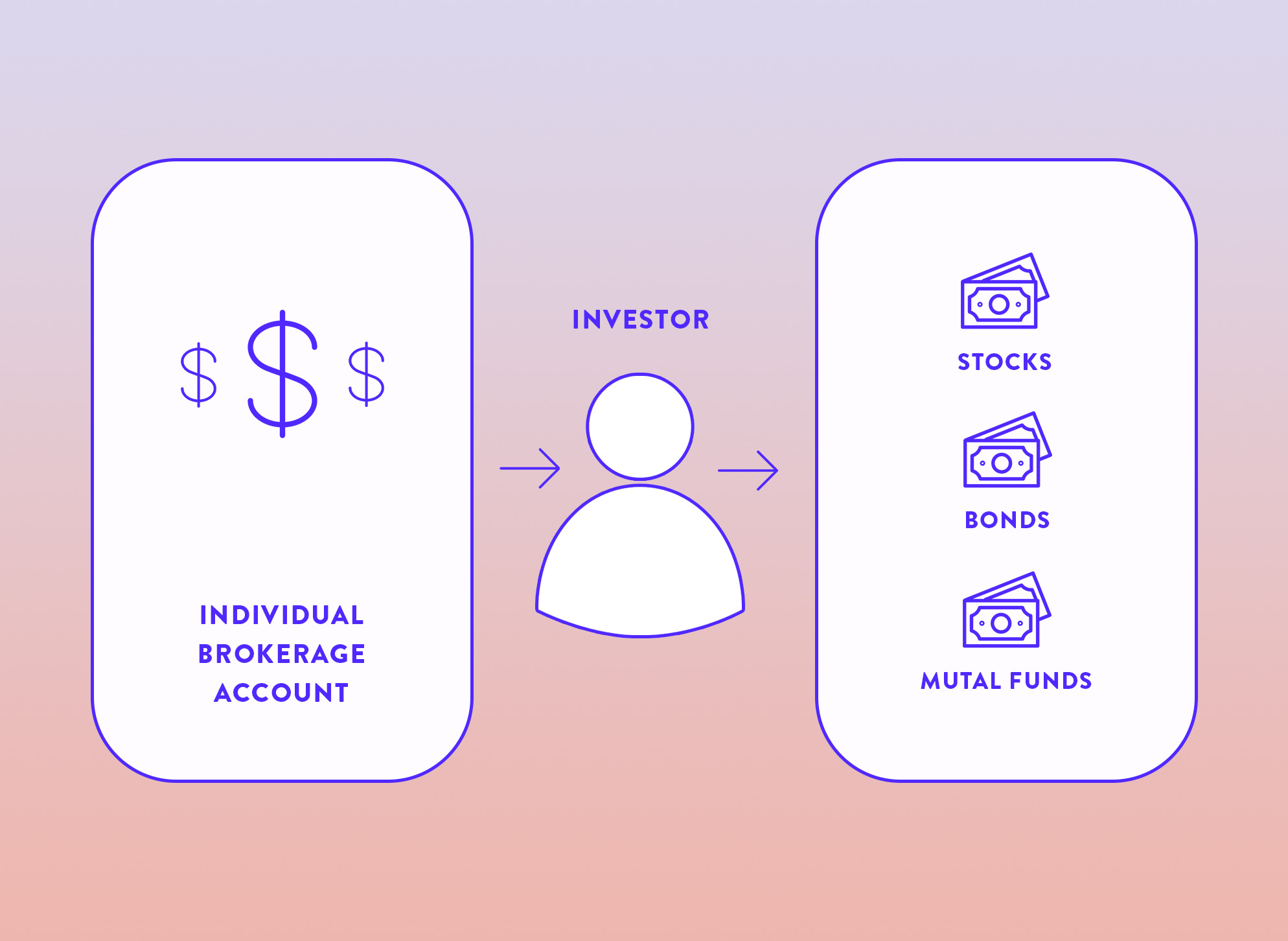
- Individual brokerage account: An business relationship that holds financial assets on behalf of an investor. The funds in a brokerage account are what investors employ to purchase and sell securities similar stocks, bonds, and mutual funds.
- Mutual fund: A mutual fund is a professionally managed investment that pools coin from a group of investors to purchase stocks, bonds, or other assets with the goal of creating a highly diversified portfolio. When one invests in a mutual fund, a professional fund manager owns the ownership of securities. While mutual funds have many benefits associated with diversification and fourth dimension savings, they as well have many drawbacks, including fees and tax inefficiency.
- ETF: An exchange-traded fund (ETF) is a bundle of several investments sold as a package. Like to a stock and unlike mutual funds, they are sold throughout the day and for a share price. They can be designed co-ordinate to market sector, geographic region, type of security, and more than.
- Index fund: A portfolio of stocks and bonds designed to mimic the performance of a financial market alphabetize such every bit the Dow Jones Industrial Average or the S&P 500. These funds have lower expenses and fees than actively managed funds and follow a passive investment strategy.

Stocks and Shares
- Security: A tradable financial asset that represents some type of fiscal value. Examples of securities include stocks and bonds.
- Fractional share: A portion of a stock that is less than one whole share. Fractional shares allow investors to purchase stocks based on a dollar amount rather than the toll of a whole share. Fractional share owners hold a portion of a full share of stock, which allows people to start investing in smaller increments and build positions in companies whose stock price may exist cost-prohibitive to them. For instance, a single share of Amazon stock currently trades at more than than $3,000 per share. Earlier partial, an investor would demand to take $iii,000+ for the full share to invest in Amazon. With partial, investors can put $five, $ten, or $fifty toward an Amazon investment and build over fourth dimension.
- Common stock: The most mutual stock bought. Each share bought is equal to a single vote at a shareholder meeting. Common stocks often, but not always, entitle their owner to a portion of the visitor's profits, which is known equally a dividend.
- Blueish-bit stocks: These are stocks issued by reputable companies with proper name recognition that feel consequent growth and provide a reliable return to investors. Many of these stocks also pay dividends. Examples include Apple, Sony, Disney, and Full general Electric.
- Small-cap stocks: These stocks are companies that have a market value ranging from $300 meg to $2 billion. The company may be at the commencement of its lifespan, serve a niche sector, or exist within a developing loonshit. They are said to be riskier investments because of their age, size, and the industries they serve.

Company Terms
- Market capitalization (marketplace cap): Market capitalization is the full value of a company. Information technology's adamant by multiplying the current marketplace price of i share of the company by the number of full outstanding shares.
- Stock split up: Stock splits are a type of corporate action in which the company's executives increment the number of shares, giving existing shareholders more than stocks proportionate to the split ratio. The price per stock then decreases proportionate to the split ratio. Companies split up stocks in order to increment stock liquidity and invite smaller investors. Information technology can bear on market demand, simply it does not change the company's value.
- Almanac ten-K filings: These are comprehensive reports filed annually by public companies. They are required by the U.Southward Securities and Exchange Commission (SEC) and disclose information nigh the company's fiscal functioning.
- Quarterly earnings reports: Quarterly filings made by public companies that disclose financial information relevant to shareholders and potential shareholders, including info about income, net sales, and earnings per share. Post-obit the release of an earnings written report, companies will hold earnings calls where investors and analysts can inquire questions. These calls are open to the public and a great opportunity to do enquiry on a company you may invest in or want to larn more than well-nigh.
- EPS: EPS stands for earnings per share, which is a company's net turn a profit divided by the number of mutual shares it has outstanding.
- Gross margin: A company's internet sales revenue minus the cost of goods sold.
- Profit and Loss (P/L): Turn a profit and loss (P&L) statements are financial reports made by companies that summarize their revenues, costs, and expenses during a specified catamenia and indicate their ability to generate turn a profit.
- Toll to earnings ratio (P/E): A measure out of the company's stock price relative to their earnings per share. This ratio is used to help decide whether companies are over or undervalued.
- Debt to equity ratio (D/E): A financial measurement that is used to analyze the corporeality of debt a company holds compared to its shareholder equity. A relatively loftier debt-to-equity ratio tells an investor that the visitor relies heavily on debt to finance operations and expansion, while a low debt-to-equity ratio tells an investor that the company does not rely on borrowing a lot of money to finance operational activeness.
- Render on equity (ROE): Considered the return on a visitor's net assets, ROE is a mensurate of a company'south profitability in relation to stockholder's equity. Information technology's calculated by dividing net income by stockholders' disinterestedness.
- Dividend payout ratio: This equals the pct of a visitor's earnings paid to shareholders in dividends.

Strategies
- Purchase-and-hold: This is a passive investment strategy in which an investor buys a blazon of securities (such every bit stocks) and holds them for an extended flow of time, regardless of fluctuations in the market.
- Short a stock: In this state of affairs, an investor borrows a stock, sells the stock, then buys it dorsum to return information technology to the lender. The seller is betting that the stock they sell will drop in price, and the profit they brand is the deviation betwixt the sell cost and the buy price.
- Take chances tolerance: How much adventure ane is willing or able to take on as an investor. Someone with trivial financial wiggle room generally has low risk tolerance vs. someone with more disposable income and/or more years until retirement.
- Diversified investments: Diversification is the process of spreading risk across investments with varying degrees of risk, for instance across companies at dissimilar stages of growth (large cap vs. minor cap) and in different sectors (e.thou. commodities vs. technology). When someone diversifies their investment portfolio, they spread their money out across a variety of companies and assets (like stocks, bonds, and commodities) in gild to reduce risk while earning the highest possible return. Diversification helps investors weather challenges that a certain segment of industries may be facing. For example, during the COVID-19 pandemic, travel stocks were hit hard, but tech stocks powering remote work, like Zoom, soared.

Options
- Call choice: A contract betwixt a buyer and a seller granting the heir-apparent the option to purchase a certain stock at a certain price until a divers expiration date.
- Long call: A phone call option that bets on the underlying stock increasing in value prior to its expiration engagement.
- Long put: A strategy used when an investor expects the underlying stock price to decrease.
- Put option: The contrary of a call option, a put option is a contract giving the stock possessor the option to sell a certain stock at a certain price within a specified time frame.
- Covered phone call: A financial transaction in which the investor selling call options owns an equal amount of the underlying stock.

The Stock Market Exchange
- Initial public offering (IPO): An initial public offering or stock market launch is the first time a company sells stocks to the public. An IPO is typically underwritten by ane or more than investment banks, who likewise arrange for the shares to exist listed on one or more stock exchanges.
- Forex: Otherwise known as the foreign substitution, this is the conversion of ane currency to another. The strange exchange market is a decentralized identify for the trading of currencies, and information technology determines foreign exchange rates for every currency.
- Dow: The Dow Jones Industrial Boilerplate is a stock market index that measures the stock performance of 30 blue-chip stocks listed on exchanges in the Us. Information technology's a cost-weighted index, which means that stocks with higher share prices acquit heavier weight than lower-priced shares.
- Nasdaq: The Nasdaq is a U.S. stock exchange that lists most of the earth's engineering science and biotech giants, including Apple, Amazon, and Google. The term besides refers to the Nasdaq Composite, an alphabetize of the stocks that are listed on the Nasdaq exchange.
- S&P 500: The South&P 500 or Standard & Poor'due south 500 Index is a market-cap-weighted alphabetize of the 500 largest publicly traded companies in the U.S.

*Offer valid for U.S. residents xviii+ and subject area to account approving. There may be other fees associated with trading. Come across more at Public.com/disclosures
*Source: Rule of Pollex For Average Stock Marketplace Return


This post is sponsored by Public.com, simply all of the opinions inside are those of The Everygirl editorial board.

Want a Week's Worth of Good for you Trader Joe'due south Recipes?
Sign up for our weekly newsletter for exclusive content straight to your inbox—including the Trader Joe's manufactures you don't want to miss!
give thanks you, I'yard already subscribed!
Source: https://theeverygirl.com/how-to-start-investing/
0 Response to "Everything You Need to Know to Start Investing Stocks"
Enregistrer un commentaire